 World Seed
Seed purity and germination standards, explained
A seed lot described as "99/85" has 99 % pure seed by weight and 85 % germination by count of normal seedlings, both measured by ISTA methods on a sample drawn from the lot. This guide explains how each figure is produced, what tolerances apply when a buyer retests, and how to combine the two into pure live seed for sowing calculations.
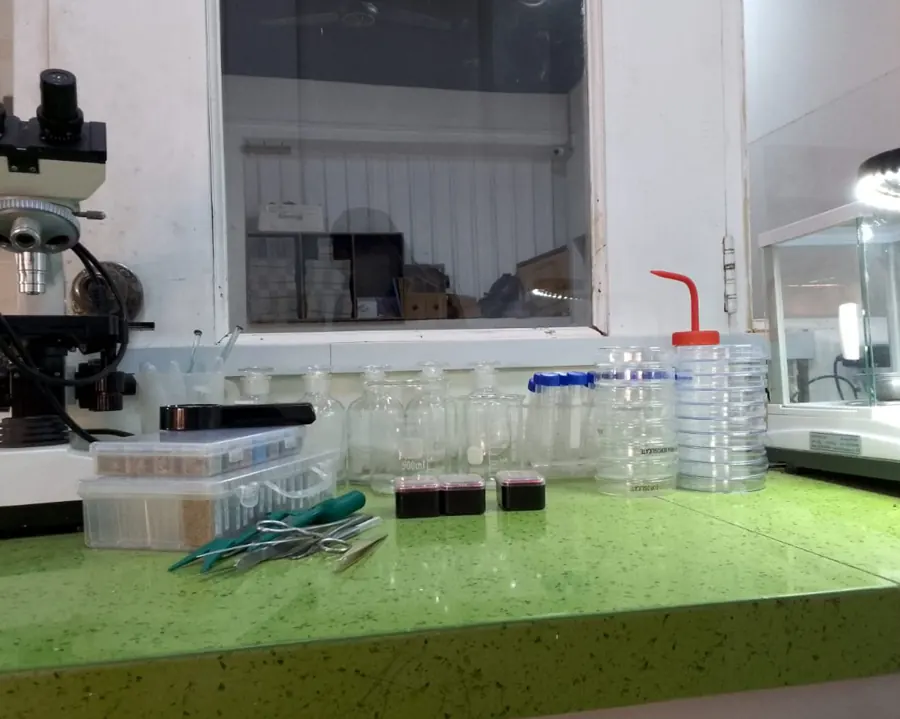
What purity measures
Purity analysis separates a working sample into four components by weight: pure seed of the named species, other crop seed, weed seed and inert matter. ISTA specifies the working-sample size by species, from about 5 g for Persian clover to 900 g for large seed; the analyst examines every particle. "Pure seed" includes immature and cracked seed of the species as long as more than half the seed remains, which is why purity says nothing about vigour. A result of 99.0 % means 990 g in every kilogram is seed of the named crop, with the remaining 10 g split between the other three components, each reported to one decimal place.
For forage grasses such as Rhodes grass, pure seed is defined by ISTA's pure seed definitions as a spikelet containing a caryopsis; empty florets go to inert matter. That is why 98 % is a strong result for Rhodes grass while 99 % is standard for round-seeded legumes like alfalfa.
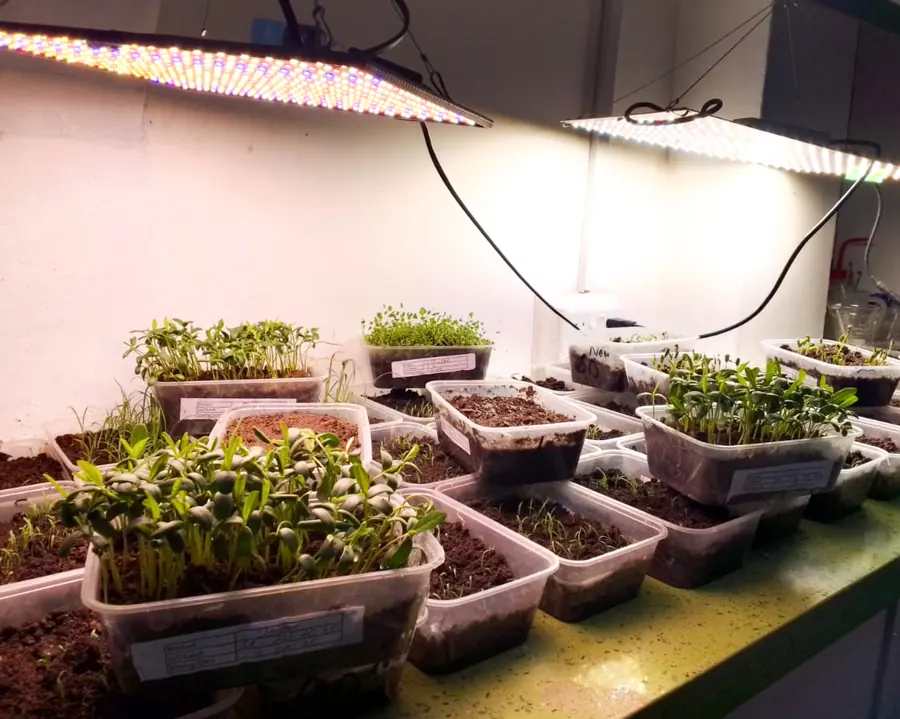
What germination measures
The germination test takes 400 pure seeds in four replicates of 100, places them on a prescribed substrate (between paper, top of paper or in sand) at a prescribed temperature regime, and counts normal seedlings at a first and final count. For alfalfa the standard is 20 °C for 7 days between paper; for sorghum 20–30 °C alternating for 10 days; for Rhodes grass 20–35 °C alternating with light for 14 days. Seedlings are classified as normal, abnormal, hard, fresh ungerminated or dead; hard seed is reported separately for legumes. A result of 85 % therefore means 85 of every 100 pure seeds produced a seedling with a healthy root and shoot under ideal conditions. Field emergence is always lower, typically 60–80 % of the laboratory figure.
Common export standards by crop
The table gives the minimum purity and germination written on Pakistani export test reports for the main crops. Individual variety pages list the full standard including moisture, inert matter and weed seed.
| Crop | Purity min | Germination min | Moisture max | Notes |
|---|---|---|---|---|
| Alfalfa (KN92, Taiztar) | 99.0 % | 85 % | 10 % | Dodder nil; hard seed reported |
| Berseem / Persian clover | 99.0 % | 85 % | 10 % | Dodder nil |
| Rhodes grass | 98.0 % | 80 % | 10 % | Spikelet with caryopsis = pure seed |
| Panicum (Mombasa / Tanzania) | 95.0 % | 70 % | 12 % | After 6-month dormancy; tetrazolium on fresh lots |
| Brachiaria (ruzi / brizantha) | 90.0 % | 60 % | 12 % | After dormancy; coated seed on PLS basis |
| Johnson grass (forage type) | 95.0 % | 75 % | 12 % | Admitting destinations only |
| Sorghum, sudan grass | 98.0 % | 85 % | 12 % | Hybridity 95 % for hybrids |
| Pearl millet (hybrid) | 98.0 % | 85 % | 12 % | Hybridity 95 % |
| Sesbania | 98.0 % | 90 % | 10 % | Scarified; hard seed reported |
| Guar | 99.0 % | 85 % | 10 % | Gum content on request |
| Ryegrass | 98.0 % | 85 % | 12 % | Ergot nil |
| Fenugreek (sowing grade) | 99.0 % | 85 % | 10 % | Phosphine fumigation only |
| Sprouting alfalfa (food grade) | 99.5 % | 90 % | 9 % | Microbial COA per lot |
| Garden cress (food / sowing grade) | 99.0 % | 90 % | 8 % | Microbial COA for sprouting lots |
| Castor (sowing grade) | 99.0 % | 85 % | 8 % | Oil 45 % min on COA |
Tolerances: when a retest differs
Two samples from the same lot never give identical results, so ISTA publishes tolerance tables for comparing a buyer's retest with the seller's certificate. For germination, the tolerance between two 400-seed tests at the 85 % level is about 7 percentage points; a certificate of 85 % and a retest of 79 % are compatible, while 76 % is a genuine discrepancy. For purity at the 99 % level the tolerance is about 0.5 points; for moisture 0.5 %. Disputes are settled by a referee test at an ISTA-accredited station on a sealed duplicate sample drawn at loading; Kohenoor's laboratory retains a sealed reference sample of every export lot for 12 months.
Pure live seed
Pure live seed (PLS) is the fraction of bag weight that will actually grow: PLS % = purity % × germination % ÷ 100. A 99/85 alfalfa lot is 84.2 % PLS; a 98/80 Rhodes grass lot is 78.4 % PLS. When a recommendation is given in PLS, divide it by the PLS fraction to get the bag rate: 8 kg PLS/ha of Rhodes grass at 78.4 % PLS needs 10.2 kg/ha of seed. The sowing rate tables and the conversion tables carry this through to acres and feddans.
| Lot | Purity | Germination | PLS | Bag rate for 20 kg PLS/ha |
|---|---|---|---|---|
| Alfalfa 99/85 | 99 % | 85 % | 84.2 % | 23.8 kg/ha |
| Alfalfa 99/90 | 99 % | 90 % | 89.1 % | 22.4 kg/ha |
| Rhodes grass 98/80 | 98 % | 80 % | 78.4 % | 25.5 kg/ha (for 20 kg PLS) |
| Sorghum 98/85 | 98 % | 85 % | 83.3 % | 24.0 kg/ha |
Frequently asked questions
What does 99/85 mean on a seed certificate?
99 % of the lot by weight is pure seed of the named species and 85 % of those seeds produced normal seedlings in an ISTA germination test. Multiply them to get 84 % pure live seed, the share of bag weight that will grow.
Why is Rhodes grass purity only 98 % when alfalfa is 99 %?
Rhodes grass seed is a spikelet, and ISTA counts only spikelets containing a caryopsis as pure seed. Empty florets are inert matter and cannot be fully removed by cleaning. 98 % is therefore a high standard for the species.
If my retest shows 80 % and the certificate says 85 %, is the seller wrong?
Not necessarily. The ISTA tolerance for two 400-seed germination tests at that level is about 7 points, so 80 % is within tolerance of 85 %. Below about 78 % the difference is significant and a referee test on the sealed duplicate sample is the next step.
Does hard seed count as germinated?
Hard seed is reported separately. It is viable seed with an impermeable coat that germinates later in the field. Some importers accept it within the germination figure up to a stated limit; the certificate shows both numbers.
How large is the sample tested?
ISTA sets working-sample sizes by species: roughly 5 g for Persian clover, 50 g for alfalfa, 90 g for sorghum, 900 g for large seed. The germination test uses 400 seeds in four replicates, drawn from bags across the lot under the ISTA sampling rules.
Get today's FOB rate
Tell us the product, quantity and destination port. The export desk replies within 24 hours with price, MOQ, documents and transit time.
export@kohenoorint.com · +92 310 4929292 · Reply within 24 hours