 World Seed
Rhodes Grass, Fine Cut (Chloris gayana)
Rhodes grass is the roughage base of the Gulf dairy industry and the most salt-tolerant of the widely traded forage grasses. The fine-cut type has thinner stems and a higher leaf share, which improves hay quality and drying speed. Agronomy, seed standards and growing regions are set out below.
Botanical identity and type
Botanical name: Chloris gayana Kunth, Poaceae.
Origin / type: East African stoloniferous grass; fine-stemmed hay selections of the Katambora/Finecut type multiplied in Sindh.
Crop type: Perennial warm-season grass for irrigated hay, pasture and dairy roughage.
Rhodes grass spreads by stolons, roots at the nodes and forms a dense, closed sward within 90 days of sowing. It tolerates soil salinity up to an ECe of 7–10 dS/m, saline irrigation water, sandy soils and 45 °C heat, which is why it dominates pivot-irrigated hay production in Saudi Arabia, the UAE and Oman and reclaimed land in Egypt and Sudan. Fine-cut selections produce more leaf and thinner stems than the coarse Callide type; hay cut at 4–5 weeks has 9–12 % crude protein, rising to 13–14 % at three weeks under high nitrogen.
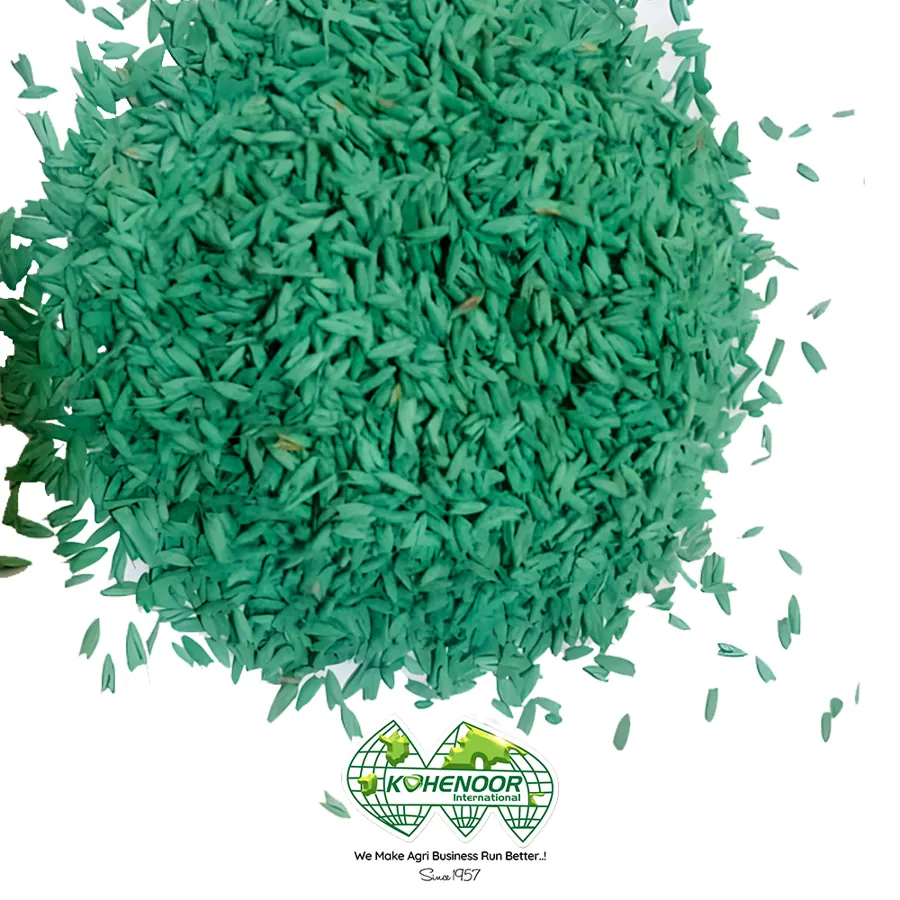
The seed is a light, fluffy spikelet with awns, about 3.5–4.5 million spikelets per kg uncoated. Purity is limited by empty florets, so ISTA defines pure seed for Rhodes grass as a spikelet containing a caryopsis; 98 % purity and 80 % germination are the working standards for uncoated seed. Coated seed flows better through pivot seeders but should be bought by pure-live-seed count. Pakistani lots are supplied uncoated unless coating is specified.
Rhodes grass gives less protein than alfalfa but uses about 30 % less water per tonne of dry matter and tolerates far more salt. Many Gulf farms run both: alfalfa for protein, Rhodes for fibre. The forage comparison covers the trade-offs; the container table shows why this light seed loads at only 10–12 MT per 20-ft box.
Agronomy at a glance
Figures are typical ranges under good management; local trials should confirm rates for a specific site. Use the sowing rate tables to convert kg/ha to per-acre, per-feddan or per-jerib rates.
| Parameter | Typical range |
|---|---|
| Sowing rate | 8–12 kg/ha uncoated; 15–20 kg/ha coated (typical) |
| Sowing depth | 0.5–1 cm; press-wheel or roll after broadcast; do not bury |
| Row spacing | Broadcast or 25–50 cm rows |
| Days to first cut | 70–90 days; then every 28–35 days |
| Cuts per year | 6–8 irrigated in the Gulf; 4–5 in subtropical rainfed |
| Yield, green | 60–100 t/ha/year (typical, irrigated) |
| Yield, dry matter | 15–25 t/ha/year |
| Crude protein | 9–12 % DM at 4–5 weeks; 12–14 % at 3 weeks |
| Soil pH | 5.5–8.5 |
| Water need | 700–1,300 mm/year irrigated; rainfed above 600 mm |
| Temperature | Optimum 25–35 °C; growth stops below 15 °C; frost kills tops only |
| Salinity tolerance | High: threshold ECe ~7 dS/m, useful to ~10–12 dS/m |
| Seeds per kg | 3.5–4.5 million spikelets (uncoated) |
Export seed standards
Standards below are those written on the ISTA-format test report issued with each export lot. See how purity and germination standards work and how to read the report.
| Parameter | Export standard | Method / note |
|---|---|---|
| Pure seed (purity) | 98.0 % min (spikelets with caryopsis) | ISTA purity analysis on a 4-component working sample |
| Germination | 80 % min | ISTA between-paper or sand test, 4 x 100 seeds, normal seedlings |
| Moisture | 10 % max | ISTA oven method (low-constant temperature, 103 °C, 17 h) |
| Inert matter | 2.0 % max | Chaff, soil, broken pieces smaller than half seed |
| Other crop seed | 0.5 % max | Seeds of any other cultivated species |
| Weed seed | 0.2 % max | By number and identity on the report |
| Coating | Uncoated (standard); coated on request | Coated lots sold on pure-live-seed basis |
Where it is grown
Seed is multiplied in Sindh (Hyderabad, Tando Allahyar, Sanghar, Umerkot) on light, mildly saline soils where the crop is sown in March–April and seed heads are harvested from September to November. Fields are cut once for fodder before being closed for seed.
Importing markets: United Arab Emirates, Saudi Arabia, Oman, Qatar, Kuwait, Bahrain, Sudan, Kenya, Ethiopia, Uganda, Tanzania, South Africa, Malaysia, Thailand. It is the standard dairy hay in the Gulf, the main reclaimed-land grass in Sudan and Kenya, and increasingly used in Malaysia and Thailand for cut-and-carry feeding.
Buying notes
Rhodes Grass, Fine Cut is exported by Kohenoor International from Karachi and Port Qasim under HS 1209.29. Standard pack is 25 kg; minimum order 1 x 20ft. New-crop seed ships from November; Gulf sowing is February–April and September–October. Every shipment carries a phytosanitary certificate (Department of Plant Protection, Pakistan), a certificate of origin, an ISTA-format purity and germination report, packing list and invoice; fumigation certificate and COA on request.
Pricing, samples and shipment planning are handled on the specialist product site: kohenoorint.com. For loading weights see the container capacity table; for destination paperwork see phytosanitary requirements by destination.
| Item | Detail |
|---|---|
| HS code | 1209.29 |
| Pack | 25 kg |
| Minimum order | 1 x 20ft |
| Purity / germination on report | 98% min / 80% min |
| Shipping terms | FOB or CIF Karachi / Port Qasim |
| Specialist site | kohenoorint.com |
Frequently asked questions
Why is Rhodes grass purity only 98 % and germination 80 %?
Rhodes grass seed is a spikelet, and some spikelets contain no caryopsis. ISTA rules count a spikelet with a caryopsis as pure seed, so 98 % purity is a high standard for this species. Germination of 80 % reflects normal dormancy in fresh lots; it often rises after 3–6 months of storage.
Should I buy coated or uncoated Rhodes grass seed?
Coated seed flows better through air seeders and pivots and is easier to spread evenly, but 40–50 % of the bag weight is coating. Compare on pure live seed per hectare, not kilograms. Pakistani export lots are uncoated unless coating is ordered.
How salt-tolerant is Rhodes grass?
It maintains full yield to about ECe 7 dS/m and useful yield to 10–12 dS/m, and tolerates irrigation water up to 6–8 dS/m with leaching. It is the most salt-tolerant of the commonly traded forage grasses.
How much does a 20-ft container hold?
Because the seed is light and bulky, a 20-ft container carries only about 10–12 MT of uncoated Rhodes grass in 25 kg bags, against 18–20 MT for alfalfa. A 40-ft high-cube carries 20–24 MT. See the container loading table.
What is the HS code for Rhodes grass seed?
HS 1209.29 (other seeds of forage plants). The phytosanitary certificate names Chloris gayana.
Need Rhodes Grass, Fine Cut seed?
The knowledge base is maintained by Kohenoor International's agronomy team. Quotes for Rhodes Grass, Fine Cut are handled by the export desk and the specialist site linked in the buying notes.
export@kohenoorint.com · +92 310 4929292 · Reply within 24 hours