 World Seed
Alfalfa KN92 (Medicago sativa)
KN92 is a non-dormant alfalfa (lucerne) selected for hot, irrigated, alkaline conditions. It is the variety most often shipped from Pakistan to the Gulf and East Africa, where it is cut every 25–30 days through most of the year. This page gives its agronomy, the seed standards it is exported under and the regions where it is grown.
Botanical identity and type
Botanical name: Medicago sativa L., Fabaceae.
Origin / type: Pakistani non-dormant cultivar selected in lower Sindh; fall dormancy class 8–9 (very non-dormant).
Crop type: Perennial multi-cut forage legume for irrigated hay, green chop and dairy rations.
KN92 was selected from Sindhi landrace alfalfa for stand persistence under 40 °C summer heat, quick regrowth after cutting and tolerance of soils with pH above 8. It does not go dormant in winter at latitudes below about 30° and therefore gives 8–10 cuts a year under irrigation in the Gulf compared with 4–6 for dormant northern cultivars. Crude protein of hay cut at early bud is typically 18–22 % on a dry-matter basis.
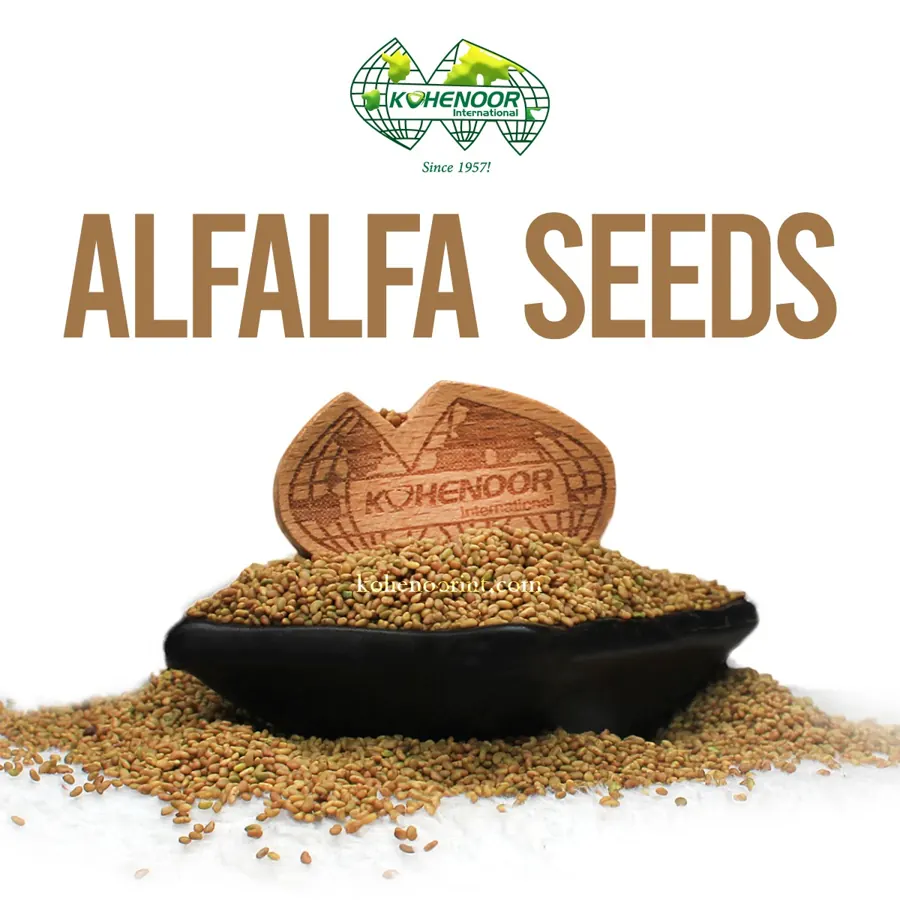
The seed is small (2.2–2.4 mm, 440,000–480,000 seeds per kilogram), olive-green to golden-brown. Hard-seed content in fresh lots is usually 5–15 %, reported separately on the ISTA report. Because the crop is grown on the Indus plain where field dodder (Cuscuta campestris) occurs, every export lot is screened for dodder in the lab and on the Sortex line; see what dodder-free means.
Compared with Taiztar, KN92 has better first-winter cold tolerance and a longer stand life (3–5 years under good drainage); Taiztar is faster in the first 60 days and slightly more heat-tolerant. Gulf hay growers commonly blend the two.
Agronomy at a glance
Figures are typical ranges under good management; local trials should confirm rates for a specific site. Use the sowing rate tables to convert kg/ha to per-acre, per-feddan or per-jerib rates.
| Parameter | Typical range |
|---|---|
| Sowing rate | 20–25 kg/ha broadcast or pivot; 15–18 kg/ha drilled (typical) |
| Sowing depth | 1–2 cm, rolled; deeper than 2.5 cm reduces emergence |
| Row spacing | Broadcast, or 15–20 cm drill rows |
| Days to first cut | 60–75 days from sowing; then 25–30 days between cuts |
| Cuts per year | 8–10 irrigated in the Gulf; 6–8 in Punjab / Upper Egypt |
| Yield, green | 80–120 t/ha/year (typical, irrigated) |
| Yield, dry matter | 18–25 t/ha/year |
| Crude protein | 18–22 % DM at early bud; 15–17 % at 10 % bloom |
| Soil pH | 6.5–8.5 (best 7.0–8.0) |
| Water need | 1,200–1,800 mm/year irrigation in arid zones; rainfed only above 600 mm |
| Temperature | Optimum 15–30 °C; survives 45 °C with water; light frost tolerated |
| Salinity tolerance | Moderate: threshold ECe ~2 dS/m, 50 % yield loss at ~9 dS/m |
| Seeds per kg | 440,000–480,000 |
Export seed standards
Standards below are those written on the ISTA-format test report issued with each export lot. See how purity and germination standards work and how to read the report.
| Parameter | Export standard | Method / note |
|---|---|---|
| Pure seed (purity) | 99.0 % min | ISTA purity analysis on a 4-component working sample |
| Germination | 85 % min (incl. hard seed up to 10 %) | ISTA between-paper or sand test, 4 x 100 seeds, normal seedlings |
| Moisture | 10 % max | ISTA oven method (low-constant temperature, 103 °C, 17 h) |
| Inert matter | 1.0 % max | Chaff, soil, broken pieces smaller than half seed |
| Other crop seed | 0.5 % max | Seeds of any other cultivated species |
| Weed seed | 0.1 % max | By number and identity on the report |
| Dodder (Cuscuta spp.) | Nil per 100 g | Lab screen plus optical sorting; stated on the certificate |
| Seed size | > 1.5 mm screen | Below-screen fraction removed as inert |
Where it is grown
In Pakistan KN92 seed is multiplied in lower Sindh (Hyderabad, Tando Allahyar, Matiari, Sanghar) and southern Punjab (Bahawalpur, Rahim Yar Khan). The crop is sown in October–November, cut for fodder through winter, allowed to flower from March and combined in May–June; new-crop lots ship from June.
The main importing markets are United Arab Emirates, Saudi Arabia, Oman, Qatar, Kuwait, Iraq, Egypt, Sudan, Iran, Uzbekistan, Kazakhstan, China, Kenya, Ethiopia. In the UAE, Saudi Arabia and Oman it is grown under centre pivots on sandy soils with 8–10 cuts; in Sudan and Egypt on Nile silt with flood irrigation; in Uzbekistan and Kazakhstan as a spring-sown crop with 3–4 cuts before winter.
Buying notes
Alfalfa KN92 is exported by Kohenoor International from Karachi and Port Qasim under HS 1214.10. Standard pack is 25 kg / 50 kg PP bags; minimum order 1 x 20ft (18–20 MT). New-crop seed ships from June; carry-over lots are retested for germination before dispatch. Every shipment carries a phytosanitary certificate (Department of Plant Protection, Pakistan), a certificate of origin, an ISTA-format purity and germination report, packing list and invoice; fumigation certificate and COA on request.
Pricing, samples and shipment planning are handled on the specialist product site: alfalfaseeds.org. For loading weights see the container capacity table; for destination paperwork see phytosanitary requirements by destination.
| Item | Detail |
|---|---|
| HS code | 1214.10 |
| Pack | 25 kg / 50 kg PP bags |
| Minimum order | 1 x 20ft (18–20 MT) |
| Purity / germination on report | 99% min / 85% min |
| Shipping terms | FOB or CIF Karachi / Port Qasim |
| Specialist site | alfalfaseeds.org |
Frequently asked questions
How many times a year can KN92 alfalfa be cut?
Under irrigation in a frost-free climate KN92 gives 8–10 cuts a year at 25–30 day intervals. In climates with a cold winter, expect 5–7 cuts. Cutting at early bud rather than full bloom keeps protein near 20 % but shortens stand life slightly.
What sowing rate should I use for KN92 under a centre pivot?
20–25 kg/ha is typical for broadcast sowing under pivot on sandy soil, giving 900–1,100 seeds per square metre. Drilled sowing on a firm seedbed can drop to 15–18 kg/ha. Sow shallow (1–2 cm) and keep the top 5 cm moist for the first 10 days.
Is KN92 seed dodder-free?
Yes. Each export lot is examined for Cuscuta seed in the laboratory (nil per 100 g) and passed over an optical sorter. The result is written on the ISTA-format test report and the phytosanitary certificate can carry an additional declaration where the importing country requires one.
What is the difference between KN92 and Taiztar alfalfa?
Both are non-dormant. KN92 has a longer stand life (3–5 years) and slightly better first-winter cold tolerance; Taiztar establishes faster and is marginally more heat-tolerant. Many Gulf growers blend them 50:50. See the Taiztar profile for its own figures.
Which HS code and documents apply to alfalfa seed imports?
Alfalfa seed for sowing is HS 1214.10 (lucerne seed). Every shipment carries a phytosanitary certificate, certificate of origin, ISTA-format test report, packing list and invoice; country-specific requirements are in the phytosanitary requirements table.
Need Alfalfa KN92 seed?
The knowledge base is maintained by Kohenoor International's agronomy team. Quotes for Alfalfa KN92 are handled by the export desk and the specialist site linked in the buying notes.
export@kohenoorint.com · +92 310 4929292 · Reply within 24 hours