 World Seed
Alfalfa Taiztar (Medicago sativa)
Taiztar is the most heat-adapted alfalfa in the Pakistani export range. It comes from the Taiz region of Yemen, where lucerne has been cut year-round for centuries, and it is now multiplied in Sindh for growers in the Arabian Peninsula, Sudan and East Africa who want fast regrowth in summer.
Botanical identity and type
Botanical name: Medicago sativa L., Fabaceae.
Origin / type: Tropical landrace type traced to the Taiz highlands of Yemen; multiplied in Sindh since the 1990s; fall dormancy class 9–10.
Crop type: Perennial, very non-dormant forage legume for hot irrigated systems.
Taiztar has fall dormancy of 9–10, meaning it keeps growing through short winter days and regrows within days of cutting. In the Gulf it is often the first stand to reach a cut after establishment, at 50–60 days, and it tolerates 45 °C with adequate water better than most cultivars. It is somewhat finer-stemmed than KN92, which helps leaf retention in baled hay, but its stand life is shorter (2–4 years) and it does not tolerate hard frost.
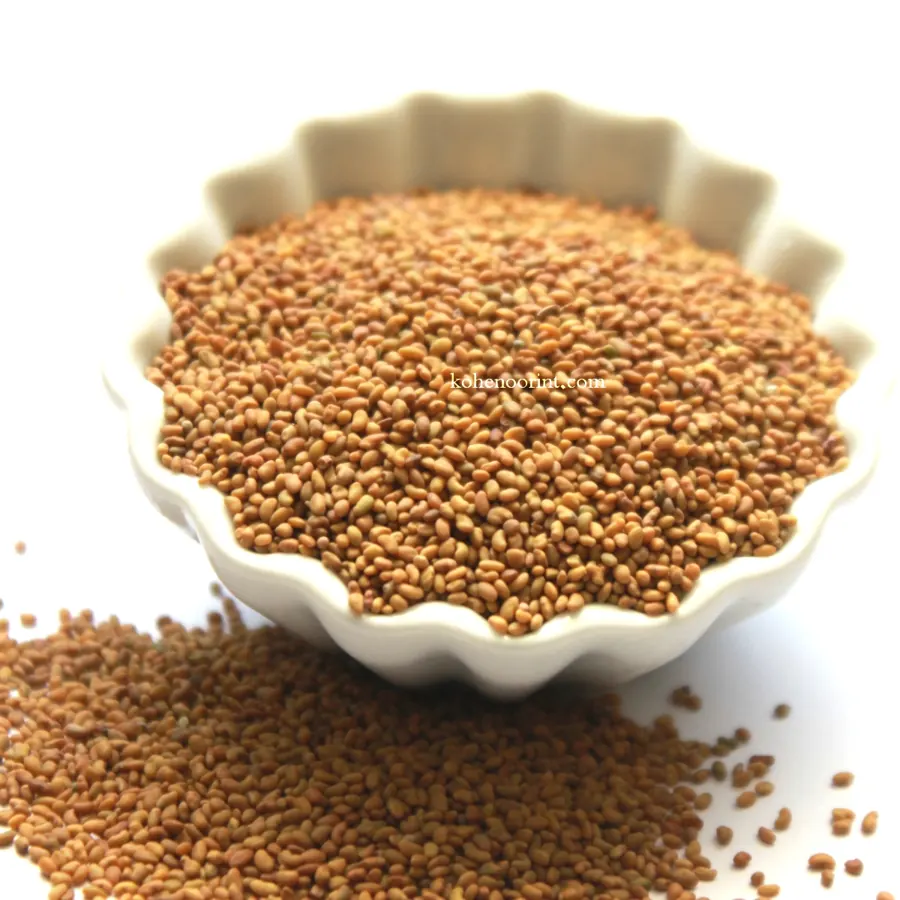
The seed is slightly smaller than KN92 (460,000–500,000 seeds per kg) and typically golden-brown. Hard seed can be higher in fresh lots (up to 15 %); lots are scarified where an importer specifies a hard-seed limit. Taiztar is grown on the same dodder-screened fields as KN92 and is exported with the same nil-dodder declaration.
Growers who need forage across a calendar year in a frost-free climate generally choose Taiztar or a Taiztar–KN92 blend. Where winters drop below −5 °C, KN92 or a dormant northern cultivar is the safer choice. The forage comparison guide sets alfalfa against berseem and Rhodes grass for the same climates.
Agronomy at a glance
Figures are typical ranges under good management; local trials should confirm rates for a specific site. Use the sowing rate tables to convert kg/ha to per-acre, per-feddan or per-jerib rates.
| Parameter | Typical range |
|---|---|
| Sowing rate | 20–25 kg/ha broadcast; 15–18 kg/ha drilled (typical) |
| Sowing depth | 1–2 cm on a rolled seedbed |
| Row spacing | Broadcast or 15–20 cm rows |
| Days to first cut | 50–65 days; 22–28 days between cuts in summer |
| Cuts per year | 9–11 in frost-free irrigated zones; 6–8 with a cool winter |
| Yield, green | 85–125 t/ha/year (typical, irrigated) |
| Yield, dry matter | 18–26 t/ha/year |
| Crude protein | 18–21 % DM at early bud |
| Soil pH | 6.5–8.5 |
| Water need | 1,300–1,900 mm/year irrigation in arid zones |
| Temperature | Optimum 20–35 °C; tolerates 45 °C; damaged below −5 °C |
| Salinity tolerance | Moderate: threshold ECe ~2 dS/m |
| Seeds per kg | 460,000–500,000 |
Export seed standards
Standards below are those written on the ISTA-format test report issued with each export lot. See how purity and germination standards work and how to read the report.
| Parameter | Export standard | Method / note |
|---|---|---|
| Pure seed (purity) | 99.0 % min | ISTA purity analysis on a 4-component working sample |
| Germination | 85 % min (incl. hard seed up to 15 %) | ISTA between-paper or sand test, 4 x 100 seeds, normal seedlings |
| Moisture | 10 % max | ISTA oven method (low-constant temperature, 103 °C, 17 h) |
| Inert matter | 1.0 % max | Chaff, soil, broken pieces smaller than half seed |
| Other crop seed | 0.5 % max | Seeds of any other cultivated species |
| Weed seed | 0.1 % max | By number and identity on the report |
| Dodder (Cuscuta spp.) | Nil per 100 g | Lab screen plus optical sorting |
Where it is grown
Seed production is concentrated in Hyderabad, Tando Muhammad Khan and Badin districts of Sindh, where the crop is sown in late October, cut twice for fodder and then left to set seed for a May–June harvest. Yemen itself no longer exports significant seed, so Pakistan is the main commercial source of this type.
Importing markets: United Arab Emirates, Saudi Arabia, Oman, Qatar, Kuwait, Iraq, Egypt, Sudan, Iran, Uzbekistan, Kazakhstan, China, Kenya, Ethiopia. It performs best in the coastal and central Gulf, Sudan, Ethiopia and Kenya; in Central Asia it is used only as a spring-sown annual because of winter kill.
Buying notes
Alfalfa Taiztar is exported by Kohenoor International from Karachi and Port Qasim under HS 1214.10. Standard pack is 25 kg / 50 kg PP bags; minimum order 1 x 20ft (18–20 MT). New-crop seed ships from June. Every shipment carries a phytosanitary certificate (Department of Plant Protection, Pakistan), a certificate of origin, an ISTA-format purity and germination report, packing list and invoice; fumigation certificate and COA on request.
Pricing, samples and shipment planning are handled on the specialist product site: alfalfaseeds.org. For loading weights see the container capacity table; for destination paperwork see phytosanitary requirements by destination.
| Item | Detail |
|---|---|
| HS code | 1214.10 |
| Pack | 25 kg / 50 kg PP bags |
| Minimum order | 1 x 20ft (18–20 MT) |
| Purity / germination on report | 99% min / 85% min |
| Shipping terms | FOB or CIF Karachi / Port Qasim |
| Specialist site | alfalfaseeds.org |
Frequently asked questions
Is Taiztar suitable for Central Asia or Türkiye?
Only as a spring-sown short-rotation crop. Its fall dormancy of 9–10 means it does not harden for winter and is killed by sustained temperatures below about −5 °C. For Uzbekistan, Kazakhstan or inland Türkiye, KN92 or a dormant cultivar is the better choice.
How quickly does Taiztar reach the first cut?
Typically 50–65 days after sowing in warm conditions, about a week faster than KN92. Subsequent cuts come every 22–28 days in summer and 30–40 days in winter.
Why is hard seed higher in Taiztar lots?
Tropical alfalfa types have a higher proportion of impermeable seed coats when harvested under dry heat. ISTA reports list hard seed separately; it is viable seed that germinates later. Lots can be mechanically scarified before shipment if the buyer specifies a hard-seed limit.
What stand life should I expect?
Two to four years under good drainage and 25–30 day cutting intervals. Waterlogging, cutting below 5 cm and grazing in the first 90 days shorten it.
What pack sizes and minimum order apply?
25 kg or 50 kg PP bags, 18–20 MT per 20-ft container, minimum one container. Smaller trial quantities are handled by the sister site linked in the buying notes.
Need Alfalfa Taiztar seed?
The knowledge base is maintained by Kohenoor International's agronomy team. Quotes for Alfalfa Taiztar are handled by the export desk and the specialist site linked in the buying notes.
export@kohenoorint.com · +92 310 4929292 · Reply within 24 hours