 World Seed
Baymisaal Hybrid Pearl Millet (Pennisetum glaucum)
Baymisaal is a multi-cut pearl millet hybrid that reaches its first cut in 45–55 days, gives three to four cuts through summer and tolerates sand, 45 °C heat and short dry spells. Unlike sorghum it produces no prussic acid, so it can be grazed or green-chopped at any stage. Agronomy, standards and growing regions are below.
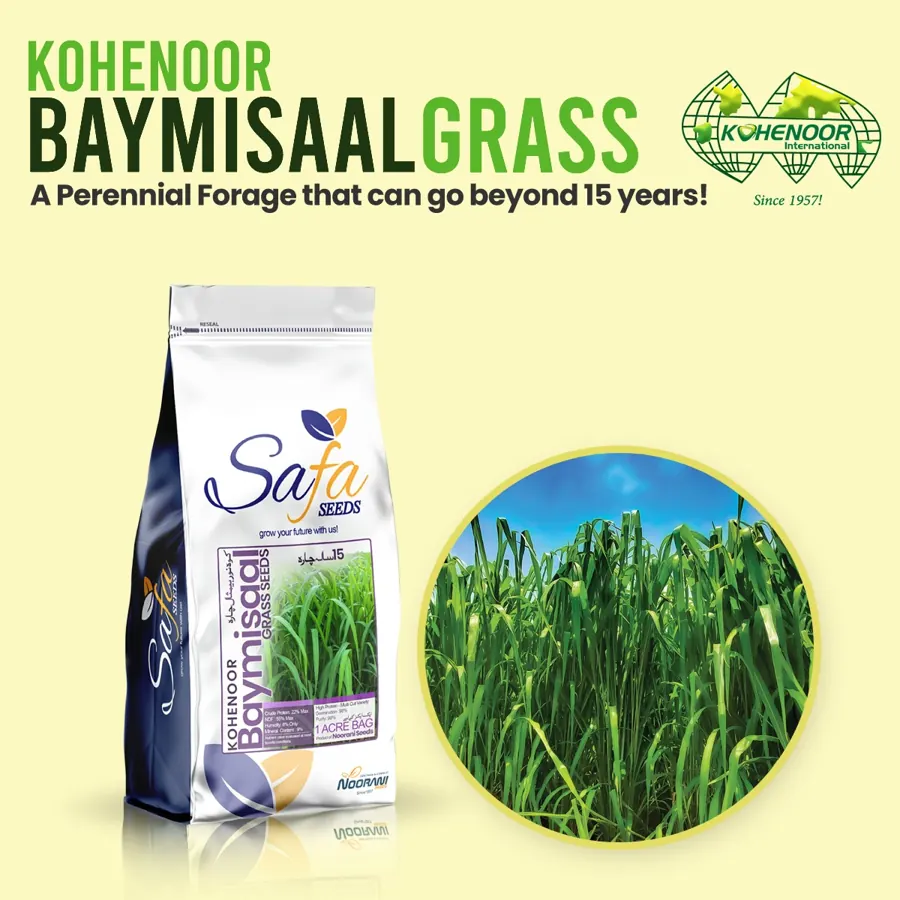
Botanical identity and type
Botanical name: Pennisetum glaucum (L.) R. Br. (syn. Cenchrus americanus), Poaceae.
Origin / type: Pakistani multi-cut forage hybrid selected for the Indus plain and Gulf pivots.
Crop type: Annual warm-season multi-cut fodder hybrid with no prussic acid.
Pearl millet is the cereal of the Sahel and the Thar: it germinates at soil temperatures over 30 °C, sets roots to 1.5 m and continues growing when sorghum pauses. The Baymisaal hybrid is leafy, tillers freely, grows 2–2.5 m and regrows from the base after cutting at 10–15 cm. Green forage at 45–55 days carries 9–12 % crude protein, rising to 12–14 % in young regrowth under nitrogen; dry-matter digestibility is similar to sudan grass. Total green yield of 70–100 t/ha over a season is typical on Gulf pivots and Punjab canal land.
The absence of prussic acid (dhurrin) is the main management advantage over sorghum: young regrowth, drought-stressed stands and frosted plants can all be fed safely. Nitrate can still accumulate under drought followed by heavy nitrogen, as in any grass. Seed is small (about 90,000–110,000 seeds per kg), grey-green, and must be sown shallow into warm soil.
Compare with BMR 313 (more tonnage per cut, prussic acid) and sudan grass (better hay) in the sorghum vs pearl millet guide. The export calendar shows the November shipping window for new-crop hybrid seed.
Agronomy at a glance
Figures are typical ranges under good management; local trials should confirm rates for a specific site. Use the sowing rate tables to convert kg/ha to per-acre, per-feddan or per-jerib rates.
| Parameter | Typical range |
|---|---|
| Sowing rate | 8–10 kg/ha drilled; 12–15 kg/ha broadcast (typical) |
| Sowing depth | 2–3 cm; shallower on crusting soils |
| Row spacing | 30–45 cm rows |
| Days to first cut | 45–55 days; then 30–35 days between cuts |
| Cuts per season | 3–4 |
| Yield, green | 70–100 t/ha per season, all cuts (typical, irrigated) |
| Yield, dry matter | 15–20 t/ha per season |
| Crude protein | 9–12 % DM; 12–14 % in young regrowth |
| Soil pH | 6.0–8.5; tolerates light, sandy soils |
| Water need | 350–600 mm per season |
| Temperature | Optimum 28–38 °C; sow above 20 °C soil; frost kills |
| Salinity tolerance | Moderate: threshold ECe ~5 dS/m |
| Seeds per kg | 90,000–110,000 |
Export seed standards
Standards below are those written on the ISTA-format test report issued with each export lot. See how purity and germination standards work and how to read the report.
| Parameter | Export standard | Method / note |
|---|---|---|
| Pure seed (purity) | 98.0 % min | ISTA purity analysis on a 4-component working sample |
| Germination | 85 % min | ISTA between-paper or sand test, 4 x 100 seeds, normal seedlings |
| Moisture | 12 % max | ISTA oven method (low-constant temperature, 103 °C, 17 h) |
| Inert matter | 2.0 % max | Chaff, soil, broken pieces smaller than half seed |
| Other crop seed | 0.5 % max | Seeds of any other cultivated species |
| Weed seed | 0.1 % max | By number and identity on the report |
| Genetic purity (hybridity) | 95 % min | Grow-out test |
| Ergot (Claviceps fusiformis) | Nil | Visual and sieve check |
Where it is grown
Hybrid seed is produced under isolation in Sindh (Sanghar, Mirpurkhas, Tharparkar) and southern Punjab from March–April sowings, harvested September–October and released in November after hybridity and germination tests.
Importing markets: Sudan, Kenya, Ethiopia, Uganda, Tanzania, Nigeria, Chad, United Arab Emirates, Saudi Arabia. It is the summer fodder for dairy and goat units in Sudan, Kenya, Ethiopia, Uganda and Tanzania, for Sahelian West Africa, and for Gulf pivots where it replaces sorghum on very sandy soils.
Buying notes
Baymisaal Hybrid Pearl Millet is exported by Kohenoor International from Karachi and Port Qasim under HS 1008.21. Standard pack is 25 kg; minimum order 1 x 20ft. New-crop hybrid seed ships from November for spring sowing. Every shipment carries a phytosanitary certificate (Department of Plant Protection, Pakistan), a certificate of origin, an ISTA-format purity and germination report, packing list and invoice; fumigation certificate and COA on request.
Pricing, samples and shipment planning are handled on the specialist product site: kohenoorint.com. For loading weights see the container capacity table; for destination paperwork see phytosanitary requirements by destination.
| Item | Detail |
|---|---|
| HS code | 1008.21 |
| Pack | 25 kg |
| Minimum order | 1 x 20ft |
| Purity / germination on report | 98% min / 85% min |
| Shipping terms | FOB or CIF Karachi / Port Qasim |
| Specialist site | kohenoorint.com |
Frequently asked questions
Does pearl millet contain prussic acid?
No. Pearl millet does not produce dhurrin, the compound that forms prussic acid in sorghum, so it can be grazed or chopped at any growth stage and after drought or frost without that risk.
How many cuts does Baymisaal give?
Three to four cuts in a 150-day summer season: first at 45–55 days, then every 30–35 days. Cutting at 10–15 cm stubble before heading keeps protein above 10 % and regrowth vigorous.
Pearl millet or sorghum for sandy Gulf soils?
Pearl millet. It germinates at higher soil temperatures, roots deeper into sand and tolerates short water stress better. Sorghum yields more per cut on heavier soils with reliable water.
Can I save seed from Baymisaal?
No. It is an F1 hybrid; saved seed segregates and loses the multi-cut vigour. Buy certified F1 seed each season.
What is the HS code for pearl millet seed?
HS 1008.21 (millet seed for sowing). Each shipment carries a phytosanitary certificate, certificate of origin and ISTA-format test report.
Need Baymisaal Hybrid Pearl Millet seed?
The knowledge base is maintained by Kohenoor International's agronomy team. Quotes for Baymisaal Hybrid Pearl Millet are handled by the export desk and the specialist site linked in the buying notes.
export@kohenoorint.com · +92 310 4929292 · Reply within 24 hours