 World Seed
Berseem Clover (Trifolium alexandrinum)
Berseem is the main winter fodder of the Indus and Nile valleys. The Mescavi type exported from Pakistan branches from the crown and gives four to six cuts between December and May. This page covers its agronomy, seed standards and where it is grown and imported.
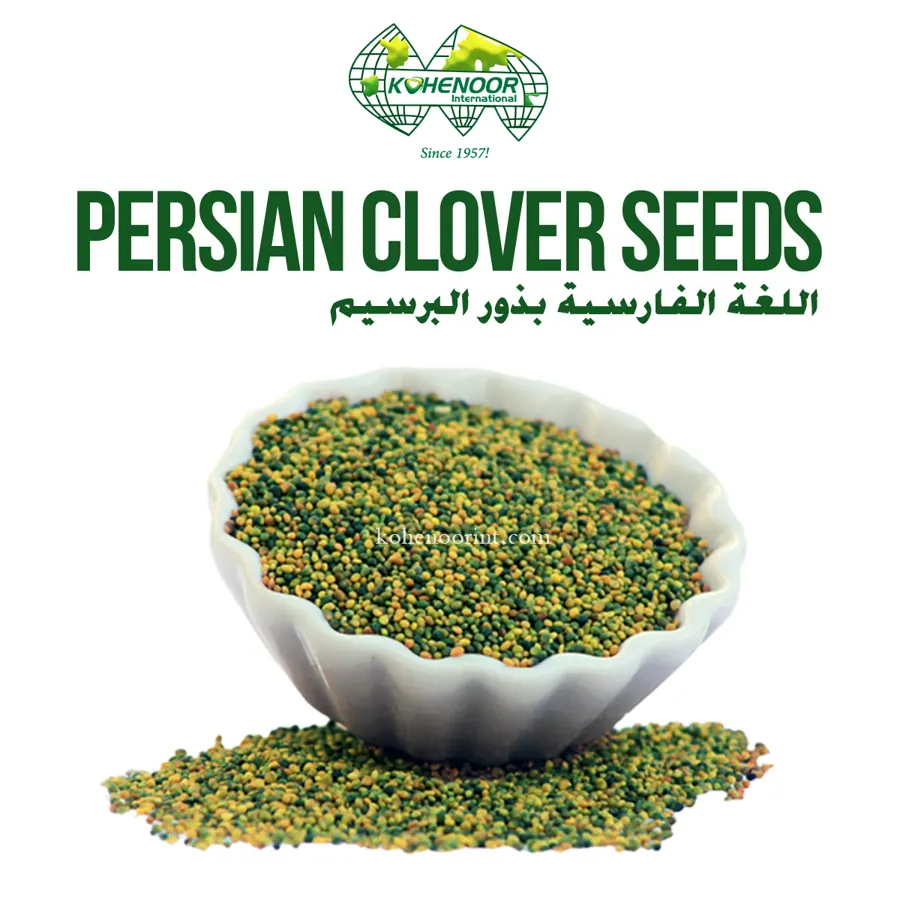
Botanical identity and type
Botanical name: Trifolium alexandrinum L., Fabaceae.
Origin / type: Egyptian clover; Mescavi (multi-cut) type, Pakistani selections from Punjab and Sindh.
Crop type: Annual winter forage legume, 4–6 cuts, also green manure.
Berseem is an erect, hollow-stemmed annual clover sown in autumn when day temperatures fall below 30 °C. Mescavi-type cultivars (the name is from the Egyptian miskawi) regrow from crown buds after each cut, unlike the single-cut Fahl type. Under irrigation in Punjab a stand sown in early October gives its first cut at 50–60 days and then a cut every 25–35 days until heat ends growth in May. Protein of green forage is 18–20 % of dry matter and it is highly palatable; bloat risk exists on very lush growth.
The seed is small (about 500,000–550,000 seeds per kg), yellow to reddish-brown, and often carries a coating of Rhizobium trifolii on request. Berseem seed is prone to admixture with wild clover and chicory, so export lots are cleaned on gravity separators and the ISTA report lists other-crop and weed seed by name. Dodder is screened as for alfalfa.
Growers choosing between berseem and alfalfa for a single winter season generally take berseem: it establishes faster, yields more in the first 120 days and costs less per hectare in seed. Alfalfa wins for stands kept longer than one season. See the comparison guide and the Persian clover profile for cooler sites.
Agronomy at a glance
Figures are typical ranges under good management; local trials should confirm rates for a specific site. Use the sowing rate tables to convert kg/ha to per-acre, per-feddan or per-jerib rates.
| Parameter | Typical range |
|---|---|
| Sowing rate | 25–30 kg/ha broadcast in standing water or on moist seedbed (typical) |
| Sowing depth | Surface to 1 cm; seed is broadcast into 3–5 cm of water then drained |
| Row spacing | Broadcast; drilled at 20 cm rows where mechanised |
| Days to first cut | 50–60 days |
| Cuts per season | 4–6 (October sowing, cuts to May) |
| Yield, green | 60–90 t/ha per season (typical, irrigated) |
| Yield, dry matter | 10–14 t/ha per season |
| Crude protein | 18–20 % DM |
| Soil pH | 6.5–8.5; tolerates mild alkalinity |
| Water need | 500–800 mm over the season; irrigation every 10–15 days |
| Temperature | Optimum 15–25 °C; growth stops above 35 °C; tolerates light frost |
| Salinity tolerance | Moderately sensitive: threshold ECe ~1.5 dS/m |
| Seeds per kg | 500,000–550,000 |
Export seed standards
Standards below are those written on the ISTA-format test report issued with each export lot. See how purity and germination standards work and how to read the report.
| Parameter | Export standard | Method / note |
|---|---|---|
| Pure seed (purity) | 99.0 % min | ISTA purity analysis on a 4-component working sample |
| Germination | 85 % min | ISTA between-paper or sand test, 4 x 100 seeds, normal seedlings |
| Moisture | 10 % max | ISTA oven method (low-constant temperature, 103 °C, 17 h) |
| Inert matter | 1.0 % max | Chaff, soil, broken pieces smaller than half seed |
| Other crop seed | 0.5 % max | Seeds of any other cultivated species |
| Weed seed | 0.2 % max | By number and identity on the report |
| Dodder (Cuscuta spp.) | Nil per 100 g | Lab screen |
| Rhizobium inoculation | On request | Peat-based inoculant applied before bagging |
Where it is grown
Pakistani berseem seed comes mainly from central and southern Punjab (Sahiwal, Okara, Faisalabad, Bahawalnagar) and from Hyderabad and Tando Allahyar in Sindh. The crop is sown in October, cut two or three times for fodder, then left to flower in March; seed is threshed in late April to May and new-crop lots ship from June.
Importing markets: Iraq, Jordan, Egypt, Libya, Tunisia, Morocco, Algeria, Iran, Afghanistan, Bangladesh, Nepal, Albania. It is the standard winter fodder in Iraq, Jordan and Egypt, and is used in Afghanistan, Bangladesh and Nepal as a rotation crop before summer cereals.
Buying notes
Berseem Clover (Mescavi type) is exported by Kohenoor International from Karachi and Port Qasim under HS 1209.22. Standard pack is 25 kg / 50 kg; minimum order 1 x 20ft. New-crop seed ships from June; sowing in most importing countries is September–November. Every shipment carries a phytosanitary certificate (Department of Plant Protection, Pakistan), a certificate of origin, an ISTA-format purity and germination report, packing list and invoice; fumigation certificate and COA on request.
Pricing, samples and shipment planning are handled on the specialist product site: cloverseeds.org. For loading weights see the container capacity table; for destination paperwork see phytosanitary requirements by destination.
| Item | Detail |
|---|---|
| HS code | 1209.22 |
| Pack | 25 kg / 50 kg |
| Minimum order | 1 x 20ft |
| Purity / germination on report | 99% min / 85% min |
| Shipping terms | FOB or CIF Karachi / Port Qasim |
| Specialist site | cloverseeds.org |
Frequently asked questions
What is the difference between Mescavi and Fahl berseem?
Mescavi is a multi-cut type that regrows from the crown after each cut and gives 4–6 cuts. Fahl is an early single-cut type used as a catch crop before cotton. Pakistani export lots are Mescavi type unless stated otherwise.
How is berseem seed usually sown?
In flood-irrigated systems the seed is broadcast into 3–5 cm of standing water on a puddled or well-prepared field, and the water is drained after 24 hours. On drained land it is broadcast onto a moist seedbed and lightly harrowed. Sowing depth should not exceed 1 cm.
Does berseem need inoculation?
Fields that have grown berseem or other clovers in the last three years usually carry adequate native Rhizobium. New land, sandy soils and reclaimed desert benefit from inoculation; peat-based inoculant can be applied to export lots on request.
What is the yield of berseem compared with alfalfa in one winter?
Over a single October-to-May season berseem typically produces 60–90 t/ha green forage against 40–60 t/ha for a first-year alfalfa stand. Alfalfa overtakes it from the second year because berseem must be resown each autumn.
Which HS code applies to berseem seed?
Clover seed for sowing falls under HS 1209.22 (clover, Trifolium spp.). Documents shipped with each container are listed in the buying notes above.
Need Berseem Clover (Mescavi type) seed?
The knowledge base is maintained by Kohenoor International's agronomy team. Quotes for Berseem Clover (Mescavi type) are handled by the export desk and the specialist site linked in the buying notes.
export@kohenoorint.com · +92 310 4929292 · Reply within 24 hours