 World Seed
Persian Clover, Shaftal (Trifolium resupinatum)
Shaftal is the clover of the cooler valleys from Kabul to Peshawar and the Iranian plateau. It tolerates frost, waterlogging and heavier soils better than berseem, and its very small seed goes a long way. This page sets out its agronomy, seed standards and the regions that grow and import it.
Botanical identity and type
Botanical name: Trifolium resupinatum L., Fabaceae.
Origin / type: Native to the Iranian plateau and the north-west of the subcontinent; Pakistani landrace selections from Khyber Pakhtunkhwa and northern Punjab.
Crop type: Annual winter forage legume for cooler and wetter sites than berseem.
Persian clover is a prostrate-to-semi-erect annual with hollow stems and pink resupinate (inverted) flowers. It is sown in October and gives three to five cuts through winter and spring. Growth is slower than berseem in the first 60 days but it tolerates temperatures to −8 °C, standing water for several days and clay soils, which makes it the safer choice above 1,000 m or in poorly drained fields. Crude protein is 16–20 % of dry matter and it is grazed as well as cut.
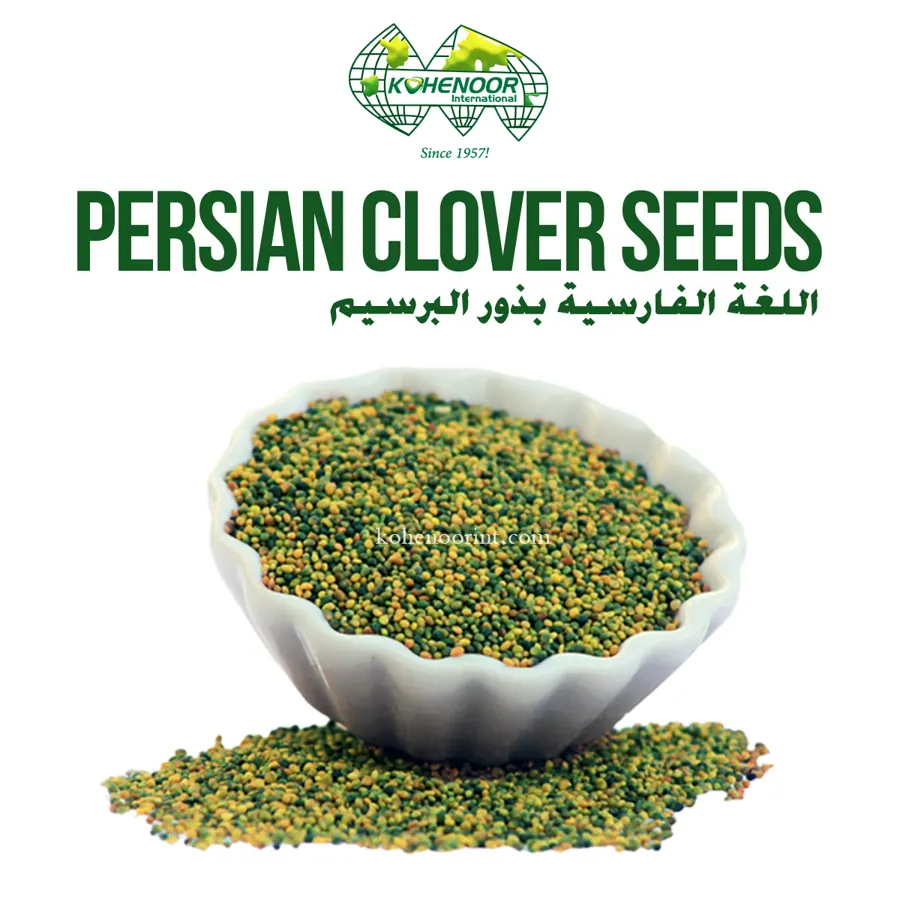
The seed is one of the smallest of the forage legumes, about 1.2–1.5 million seeds per kg, dark reddish-brown to purple. Because of the seed size, a sowing rate of 8–12 kg/ha gives a dense stand, and seed cost per hectare is low. Seed is hard to clean of small weed seeds, so Pakistani export lots are passed over indent cylinders and gravity tables and the ISTA report lists any weed species found.
Shaftal fits between berseem (warmer, wetter, higher yield) and annual ryegrass (grass, no nitrogen fixation) in the winter-forage range. In Afghanistan and Iran it is commonly mixed with ryegrass at 6 kg shaftal plus 15 kg ryegrass per hectare for a balanced cut.
Agronomy at a glance
Figures are typical ranges under good management; local trials should confirm rates for a specific site. Use the sowing rate tables to convert kg/ha to per-acre, per-feddan or per-jerib rates.
| Parameter | Typical range |
|---|---|
| Sowing rate | 8–12 kg/ha alone; 5–6 kg/ha in mixtures (typical) |
| Sowing depth | 0.5–1 cm; surface broadcast onto a firm, moist seedbed |
| Row spacing | Broadcast, or 15–20 cm drill rows |
| Days to first cut | 60–75 days |
| Cuts per season | 3–5 |
| Yield, green | 50–70 t/ha per season (typical) |
| Yield, dry matter | 8–12 t/ha per season |
| Crude protein | 16–20 % DM |
| Soil pH | 6.0–8.0; tolerates heavy clay |
| Water need | 450–700 mm; tolerates several days of waterlogging |
| Temperature | Optimum 10–25 °C; tolerates −8 °C; growth stops above 32 °C |
| Salinity tolerance | Low to moderate: threshold ECe ~1.5 dS/m |
| Seeds per kg | 1,200,000–1,500,000 |
Export seed standards
Standards below are those written on the ISTA-format test report issued with each export lot. See how purity and germination standards work and how to read the report.
| Parameter | Export standard | Method / note |
|---|---|---|
| Pure seed (purity) | 99.0 % min | ISTA purity analysis on a 4-component working sample |
| Germination | 85 % min | ISTA between-paper or sand test, 4 x 100 seeds, normal seedlings |
| Moisture | 10 % max | ISTA oven method (low-constant temperature, 103 °C, 17 h) |
| Inert matter | 1.0 % max | Chaff, soil, broken pieces smaller than half seed |
| Other crop seed | 0.5 % max | Seeds of any other cultivated species |
| Weed seed | 0.2 % max | By number and identity on the report |
| Dodder (Cuscuta spp.) | Nil per 100 g | Lab screen |
Where it is grown
Seed is produced in the Peshawar valley, Mardan and Swabi in Khyber Pakhtunkhwa and in Attock and Chakwal in northern Punjab, where the crop is sown in October and seed harvested in May. Volumes are smaller than berseem and lots are usually contracted ahead of the season.
Importing markets: Iran, Afghanistan, Jordan, Iraq, Türkiye. It is the dominant winter clover in Afghanistan and western Iran and is used in Jordan, Iraq and eastern Türkiye on heavier irrigated soils where berseem is unreliable.
Buying notes
Persian Clover (Shaftal) is exported by Kohenoor International from Karachi and Port Qasim under HS 1209.22. Standard pack is 25 kg / 50 kg; minimum order 1 x 20ft. New-crop seed ships from June; most importers sow in September–October. Every shipment carries a phytosanitary certificate (Department of Plant Protection, Pakistan), a certificate of origin, an ISTA-format purity and germination report, packing list and invoice; fumigation certificate and COA on request.
Pricing, samples and shipment planning are handled on the specialist product site: cloverseeds.org. For loading weights see the container capacity table; for destination paperwork see phytosanitary requirements by destination.
| Item | Detail |
|---|---|
| HS code | 1209.22 |
| Pack | 25 kg / 50 kg |
| Minimum order | 1 x 20ft |
| Purity / germination on report | 99% min / 85% min |
| Shipping terms | FOB or CIF Karachi / Port Qasim |
| Specialist site | cloverseeds.org |
Frequently asked questions
When should shaftal be chosen over berseem?
Choose shaftal where winter minimums drop below −3 °C, on heavy or waterlogged soils, or above about 1,000 m elevation. Choose berseem for warmer lowland sites with good drainage, where its yield is 20–30 % higher.
Why is the sowing rate so low?
Persian clover has 1.2–1.5 million seeds per kilogram, roughly three times as many as berseem. At 10 kg/ha the sowing rate delivers over 1,000 seeds per square metre, which is more than enough for a dense stand.
Can shaftal be grazed?
Yes. Its semi-prostrate growth and crown regrowth tolerate rotational grazing once plants are 20 cm tall. As with all lush legumes, introduce hungry ruminants gradually to limit bloat.
Can it be mixed with ryegrass?
A common Afghan and Iranian mix is 5–6 kg/ha shaftal with 15–20 kg/ha annual ryegrass. The grass provides bulk and reduces bloat; the clover provides protein and nitrogen. Sow both shallow at the same time.
What is the HS code for Persian clover seed?
HS 1209.22, the same clover heading as berseem. The phytosanitary certificate names Trifolium resupinatum.
Need Persian Clover (Shaftal) seed?
The knowledge base is maintained by Kohenoor International's agronomy team. Quotes for Persian Clover (Shaftal) are handled by the export desk and the specialist site linked in the buying notes.
export@kohenoorint.com · +92 310 4929292 · Reply within 24 hours