 World Seed
Basil Seed, Tukhm-e-Balanga (Ocimum basilicum)
Tukhm-e-balanga, also called sabja or falooda seed, is the small black seed of sweet basil that swells into a gelatinous coat within minutes in water. It is exported food-grade from Pakistan for drinks, desserts and health foods in the Gulf, South-East Asia, the UK and North America. Agronomy, specifications and growing regions follow.
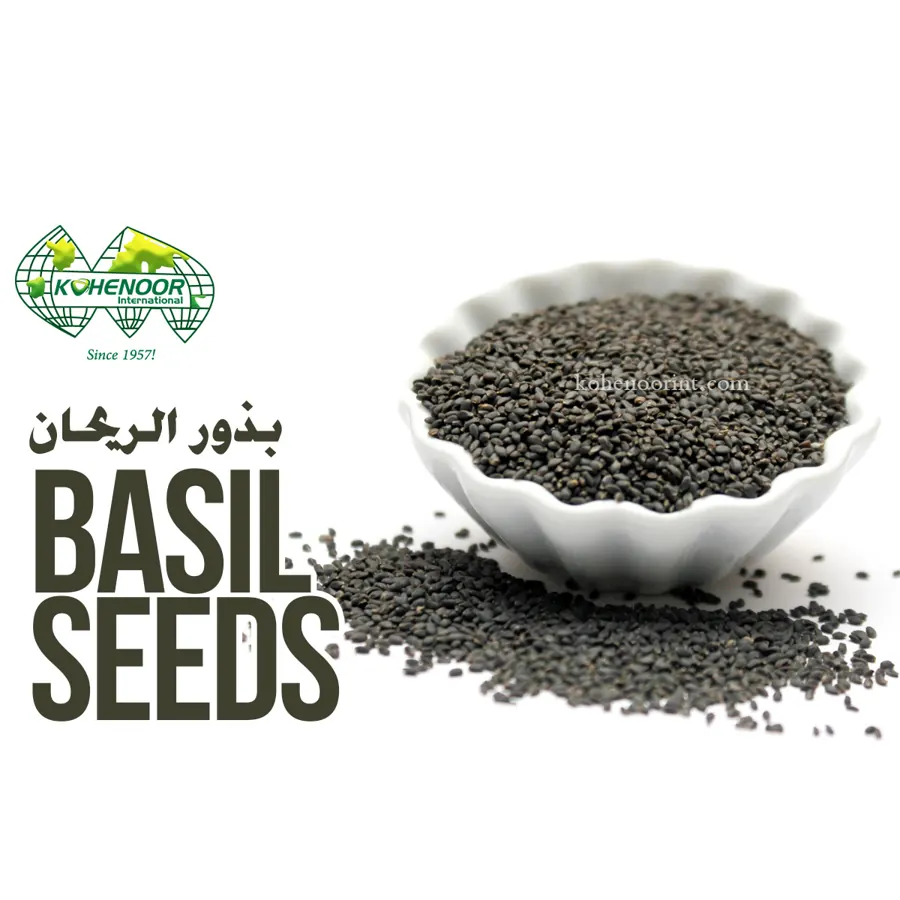
Botanical identity and type
Botanical name: Ocimum basilicum L., Lamiaceae.
Origin / type: Seed-type sweet basil landraces from Sindh and Punjab grown for the edible mucilaginous seed.
Crop type: Annual aromatic herb grown for food-grade seed used in beverages and desserts.
Seed basil is a 40–80 cm aromatic annual grown from nursery transplants or direct sowing in spring, flowering in 70–90 days and harvested for seed at 120–140 days when the lower whorls of the inflorescence turn brown. Each seed is an oval nutlet 1.5–2 mm long, matte black, with an outer layer of pectic mucilage that absorbs 15–20 times its weight of water and forms the translucent coat used in falooda, sherbet and bubble-tea-style drinks. The seed contains 14–20 % protein, 18–22 % fixed oil rich in alpha-linolenic acid and 20–25 % dietary fibre.
Because the seed is small and light, field-run lots carry dust, chaff and seeds of wild Ocimum species and amaranth. Export lots are cleaned on fine screens, destoners and gravity tables to 99 % purity and 8 % moisture and are tested for swelling (a 1 g sample in 50 ml water should form a full gel in under 10 minutes). Food-grade buyers require Salmonella-negative and heavy-metal certificates; the microbial standards guide explains the tests.
Basil seed is a food ingredient rather than planting stock; sowing-grade basil is a different, herb-type product. It is exported alongside nigella and fenugreek in the spice and herb range, and the HS code table gives its heading.
Agronomy at a glance
Figures are typical ranges under good management; local trials should confirm rates for a specific site. Use the sowing rate tables to convert kg/ha to per-acre, per-feddan or per-jerib rates.
| Parameter | Typical range |
|---|---|
| Sowing rate | 2–3 kg/ha via nursery and transplant; 4–6 kg/ha direct (typical) |
| Sowing depth | 0.5–1 cm; light covering |
| Row spacing | 30–45 cm rows, 20–30 cm in row |
| Days to harvest | 120–140 days for seed |
| Harvests per season | 1–2 (second flush in long seasons) |
| Yield, seed | 0.4–0.8 t/ha (typical) |
| Yield, herbage | 10–15 t/ha green if cut for leaf |
| Mucilage / protein | Swells 15–20 x in water; 14–20 % protein |
| Soil pH | 6.0–7.5 |
| Water need | 400–600 mm; irrigation every 7–10 days |
| Temperature | Optimum 20–32 °C; frost-sensitive |
| Salinity tolerance | Low: threshold ECe ~1.5–2 dS/m |
| Seeds per kg | 600,000–800,000 |
Export seed standards
Standards below are those written on the ISTA-format test report issued with each export lot. See how purity and germination standards work and how to read the report.
| Parameter | Export standard | Method / note |
|---|---|---|
| Purity (sound, clean seed) | 99.0 % min | Machine-cleaned; optical sorted where stated |
| Moisture | 8 % max | Oven or calibrated capacitance meter at dispatch |
| Admixture / foreign matter | 1.0 % max | Stones, stalks, dust, other seed by weight |
| Germination | Not tested — edible/spice grade | Sowing-grade lots are tested on request (ISTA method) |
| Swelling test | Full gel within 10 min | 1 g seed in 50 ml water at 25 °C |
| Other Ocimum / amaranth seed | 0.5 % max | Gravity table and optical sorting |
| Microbiology (food grade) | Salmonella absent in 25 g | Accredited laboratory COA per lot |
Where it is grown
Seed basil is grown in Sindh (Hyderabad, Tando Allahyar, Thatta) and central Punjab (Faisalabad, Sahiwal), sown in February–March and harvested July–September. Cleaning is complete by October and new-crop seed ships through the winter.
Importing markets: United Arab Emirates, Saudi Arabia, United Kingdom, United States, Malaysia. The Gulf and Malaysia use it in traditional drinks; the UK and United States in South Asian retail and health-food products.
Buying notes
Basil Seed (Tukhm-e-Balanga) is exported by Kohenoor International from Karachi and Port Qasim under HS 1209.91. Standard pack is 25 kg; minimum order 1 x 20ft. Harvest July–September; new crop from October. Every shipment carries a phytosanitary certificate (Department of Plant Protection, Pakistan), a certificate of origin, an ISTA-format purity and germination report, packing list and invoice; fumigation certificate and COA on request.
Pricing, samples and shipment planning are handled on the specialist product site: herbnseed.com. For loading weights see the container capacity table; for destination paperwork see phytosanitary requirements by destination.
| Item | Detail |
|---|---|
| HS code | 1209.91 |
| Pack | 25 kg |
| Minimum order | 1 x 20ft |
| Purity / germination on report | 99% min / n/a |
| Shipping terms | FOB or CIF Karachi / Port Qasim |
| Specialist site | herbnseed.com |
Frequently asked questions
Is basil seed the same as chia seed?
No. Basil seed (Ocimum basilicum) is black, oval and swells within minutes; chia (Salvia hispanica) is grey-speckled and swells more slowly. Both form a mucilage gel and are used similarly in drinks, but they are different plants with different HS codes.
How is the swelling quality checked?
A 1 g sample is placed in 50 ml of water at 25 °C; a full translucent gel within 10 minutes indicates sound, mature seed. Old or heat-damaged seed swells slowly and is downgraded.
Is the seed food-grade?
Yes. Export lots are cleaned to 99 % purity, dried to 8 % moisture and supplied with a certificate of analysis showing Salmonella absent in 25 g and heavy metals within Codex limits.
Can I sow tukhm-e-balanga to grow basil?
It is viable seed and will grow seed-type sweet basil, but food-grade lots are not germination-tested. For sowing, request an ISTA germination test on a specific lot.
What is the HS code for basil seed?
HS 1209.91 (vegetable seeds) is used for basil seed exported from Pakistan; some destinations classify food-use basil seed under HS 1211.90. Confirm with the importing customs broker.
Need Basil Seed (Tukhm-e-Balanga) seed?
The knowledge base is maintained by Kohenoor International's agronomy team. Quotes for Basil Seed (Tukhm-e-Balanga) are handled by the export desk and the specialist site linked in the buying notes.
export@kohenoorint.com · +92 310 4929292 · Reply within 24 hours