 World Seed
Sesbania, Dhaincha (Sesbania aculeata / S. sesban)
Dhaincha is the fastest nitrogen crop of the subcontinent: sown at the start of the monsoon, it stands 1.5–2 m in 45–60 days, fixes 80–120 kg N/ha and can be ploughed in before rice or wheat. It also grows in flooded, saline and sodic soils where little else will. Agronomy, seed standards and where it is grown are below.
Botanical identity and type
Botanical name: Sesbania aculeata (syn. S. bispinosa) and Sesbania sesban (L.) Merr., Fabaceae.
Origin / type: Indus-basin green manure and reclamation legume; Pakistani landrace seed.
Crop type: Fast-growing annual legume for green manure, saline-sodic soil reclamation and fodder.
Sesbania aculeata is an erect, lightly branched annual with pinnate leaves and a stem that stays soft enough to plough under at 50–60 days, when it contains 2.5–3.5 % nitrogen and 20–30 t/ha of green matter. It nodulates abundantly with native rhizobia, forms stem nodules when flooded, and tolerates standing water, soil pH to 9.5 and ECe above 8 dS/m. That combination makes it the standard reclamation crop for sodic soils after gypsum and a green manure before transplanted rice across the Indus and Nile basins. S. sesban is a shrubbier perennial type used for cut fodder and as a hedge; its leaves carry 20–25 % crude protein and are fed to goats and cattle.
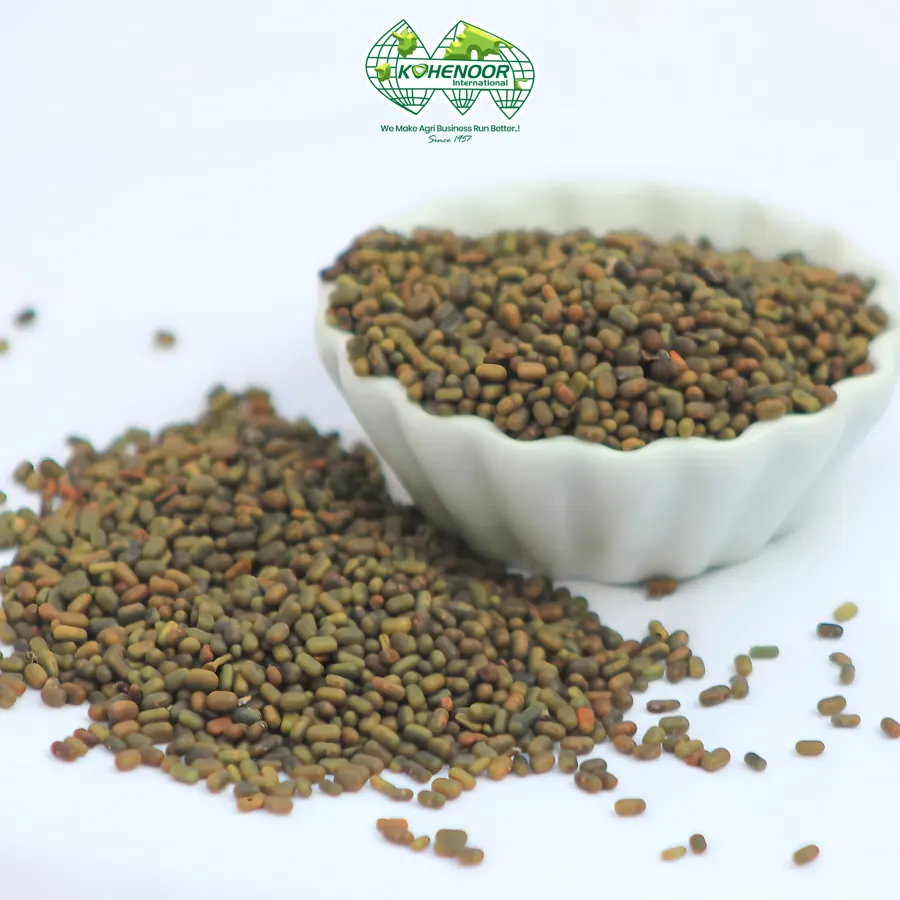
Seed is small (about 60,000–80,000 seeds per kg), olive to dark brown, and hard-seeded; germination of 90 % is achieved on scarified or hot-water-treated lots and ISTA reports list hard seed separately. Export lots are cleaned to 98 % purity and are free of the Sesbania pod-borer and bruchid damage that lowers viability in farm-saved seed.
Growers use sesbania where berseem or alfalfa would not survive the waterlogging or the sodicity. It is also a component of tropical agroforestry in Taiwan, Korea and Vietnam for organic rice. The export calendar shows the November-onwards shipping window.
Agronomy at a glance
Figures are typical ranges under good management; local trials should confirm rates for a specific site. Use the sowing rate tables to convert kg/ha to per-acre, per-feddan or per-jerib rates.
| Parameter | Typical range |
|---|---|
| Sowing rate | 40–60 kg/ha broadcast for green manure; 25–30 kg/ha in rows for fodder or seed (typical) |
| Sowing depth | 2–3 cm; broadcast into puddled soil or moist seedbed |
| Row spacing | Broadcast; 30 cm rows for seed crop |
| Days to incorporation / first cut | 45–60 days to plough in; 60–75 days for first fodder cut |
| Cuts per season | 1 (green manure); 2–3 for S. sesban fodder |
| Yield, green | 20–35 t/ha at 50 days (typical) |
| Yield, dry matter | 4–7 t/ha at 50 days |
| Nitrogen fixed | 80–120 kg N/ha in 50–60 days |
| Crude protein | 20–25 % DM in leaf; 12–15 % whole plant |
| Soil pH | 5.5–9.5; tolerates sodic soils |
| Water need | 400 mm plus; tolerates flooding |
| Temperature | Optimum 25–38 °C; frost kills |
| Salinity tolerance | High: grows at ECe 8–10 dS/m |
| Seeds per kg | 60,000–80,000 |
Export seed standards
Standards below are those written on the ISTA-format test report issued with each export lot. See how purity and germination standards work and how to read the report.
| Parameter | Export standard | Method / note |
|---|---|---|
| Pure seed (purity) | 98.0 % min | ISTA purity analysis on a 4-component working sample |
| Germination | 90 % min (scarified; hard seed reported separately) | ISTA between-paper or sand test, 4 x 100 seeds, normal seedlings |
| Moisture | 10 % max | ISTA oven method (low-constant temperature, 103 °C, 17 h) |
| Inert matter | 2.0 % max | Chaff, soil, broken pieces smaller than half seed |
| Other crop seed | 0.5 % max | Seeds of any other cultivated species |
| Weed seed | 0.2 % max | By number and identity on the report |
| Insect damage | 1 % max by count | Bruchid-damaged seed removed on gravity table |
Where it is grown
Seed is produced in the rice tracts of Sindh (Larkana, Shikarpur, Thatta) and Punjab (Sheikhupura, Gujranwala), sown in April–June and harvested October–November. Pakistan is one of the largest commercial sources of dhaincha seed.
Importing markets: Egypt, Sudan, Taiwan, South Korea, Vietnam, Bangladesh, Kenya, Ethiopia, South Africa, Nigeria, Chad, India. Egypt and Sudan use it for reclaiming saline land; Taiwan, Korea and Vietnam for organic rice green manure; Kenya, Ethiopia, Nigeria and Chad for soil improvement and goat fodder; India and Bangladesh for pre-rice green manure.
Buying notes
Sesbania (Dhaincha) is exported by Kohenoor International from Karachi and Port Qasim under HS 1209.99. Standard pack is 25 kg / 50 kg; minimum order 1 x 20ft. New-crop seed ships from November. Every shipment carries a phytosanitary certificate (Department of Plant Protection, Pakistan), a certificate of origin, an ISTA-format purity and germination report, packing list and invoice; fumigation certificate and COA on request.
Pricing, samples and shipment planning are handled on the specialist product site: sesbaniaseed.com. For loading weights see the container capacity table; for destination paperwork see phytosanitary requirements by destination.
| Item | Detail |
|---|---|
| HS code | 1209.99 |
| Pack | 25 kg / 50 kg |
| Minimum order | 1 x 20ft |
| Purity / germination on report | 98% min / 90% min |
| Shipping terms | FOB or CIF Karachi / Port Qasim |
| Specialist site | sesbaniaseed.com |
Frequently asked questions
How much nitrogen does sesbania add to the soil?
A 50–60 day stand ploughed under typically fixes and returns 80–120 kg N/ha, of which about half is available to the following rice or wheat crop. Biomass of 20–30 t/ha green also adds organic matter.
When should dhaincha be ploughed in?
At 45–60 days, before the stems lignify, when plants are 1.5–2 m and beginning to flower. Later incorporation gives more biomass but the woody stem decomposes slowly and can immobilise nitrogen.
Does sesbania need scarification?
Fresh seed is hard-seeded. Export lots are mechanically scarified to reach 90 % germination; farm-saved seed can be soaked in hot water (80 °C) for one minute or in water overnight before sowing.
Can it reclaim sodic soil?
Yes. Sesbania tolerates pH up to 9.5 and exchangeable sodium that kills most crops. Two seasons of dhaincha with gypsum and leaching typically bring a sodic field into rice or wheat production.
What is the HS code for sesbania seed?
HS 1209.99 (other seeds for sowing). The phytosanitary certificate names Sesbania aculeata or Sesbania sesban as ordered.
Need Sesbania (Dhaincha) seed?
The knowledge base is maintained by Kohenoor International's agronomy team. Quotes for Sesbania (Dhaincha) are handled by the export desk and the specialist site linked in the buying notes.
export@kohenoorint.com · +92 310 4929292 · Reply within 24 hours