 World Seed
Garden Cress, Halim (Lepidium sativum)
Garden cress is the fastest sprouting seed in commerce: it germinates in 24–36 hours, gives a peppery microgreen in five to seven days and is eaten as a whole seed (halim, hab al-rashad) across South Asia and the Middle East. Its 1000-seed weight is about 2.5 g. Pakistani lots are exported food-grade for sprouting under the EU microbial rules, and sowing-grade for growers. Agronomy, seed standards and regions are set out below.
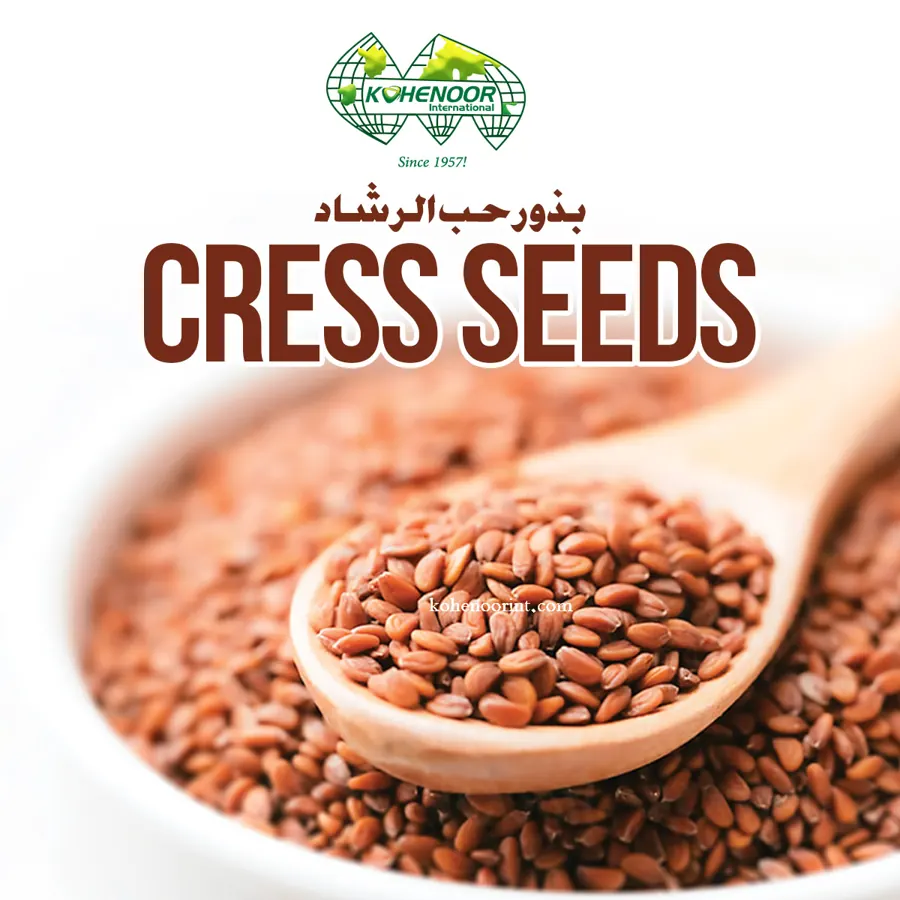
Botanical identity and type
Botanical name: Lepidium sativum L., Brassicaceae.
Origin / type: Cool-season annual of Egyptian and West Asian origin; bold-seeded Pakistani landrace (halim, hab al-rashad) from Sindh and Punjab.
Crop type: Annual cool-season herb grown for seed used in sprouting, microgreens, health food and traditional medicine, and for sowing.
Cress is a 30–60 cm annual of the mustard family with finely divided leaves, small white flowers and flat, notched pods holding two reddish-brown seeds each. Sown in October–November in Pakistan it flowers in 60–70 days and is harvested for seed in 100–120 days, when the pods turn straw-coloured but before they split. Yield is 0.8–1.5 t/ha. The seed carries 20–25 % oil, of which about 30 % is alpha-linolenic acid, 22–25 % protein and a mucilage layer that swells in water, which is why it is used in restorative foods and as a thickener as well as a sprouting seed. The pungency comes from benzyl isothiocyanate released from glucotropaeolin.
Two grades are exported. Food-grade sprouting seed is grown under contract on fields without manure, cleaned on air-screen, gravity and optical lines to 99 % purity and 8 % moisture, tested at 90 % germination so that trays fill evenly in three days, and supplied with a microbiological certificate: Salmonella absent in 25 g and Shiga-toxin-producing E. coli (STEC) absent, as required for seed for sprouting under Regulation (EC) 2073/2005 as amended by Regulation (EU) 209/2013, with traceability under Regulation (EU) 208/2013; the sprouting seed standards guide explains the tests. Sowing grade carries the same ISTA germination report and is fumigated with phosphine only.
Cress joins alfalfa and fenugreek in the Pakistani sprouting-seed range and shares its cool season with nigella and cumin. The HS code table gives its heading; the storage guide explains why it ships at 8 % moisture.
Agronomy at a glance
Figures are typical ranges under good management; local trials should confirm rates for a specific site. Use the sowing rate tables to convert kg/ha to per-acre, per-feddan or per-jerib rates.
| Parameter | Typical range |
|---|---|
| Sowing rate | 8–12 kg/ha for a seed crop (typical); 40–60 g/m² of tray for microgreens |
| Sowing depth | 0.5–1 cm; surface-sown and pressed for microgreens |
| Row spacing | 20–30 cm rows, or broadcast |
| Days to harvest | 100–120 days for seed; 5–7 days for microgreens; 2–3 days for sprouts |
| Harvests per season | 1 seed harvest |
| Yield, seed | 0.8–1.5 t/ha (typical) |
| Yield, microgreens | 1.5–2.5 kg per m² of tray per cycle |
| Oil / protein | 20–25 % oil (about 30 % ALA); 22–25 % protein; mucilage 5–8 % |
| Soil pH | 6.0–7.5 |
| Water need | 300–400 mm; 3–4 light irrigations; dry weather at maturity |
| Temperature | Optimum 10–25 °C; tolerates light frost; bolts above 30 °C |
| Salinity tolerance | Low: threshold ECe ~1.5–2 dS/m |
| Seeds per kg | 380,000–420,000 (1000-seed weight ~2.5 g) |
Export seed standards
Standards below are those written on the ISTA-format test report issued with each export lot. See how purity and germination standards work and how to read the report.
| Parameter | Export standard | Method / note |
|---|---|---|
| Pure seed (purity) | 99.0 % min (food grade 99.5 %) | ISTA purity analysis on a 4-component working sample |
| Germination | 90 % min | ISTA between-paper or sand test, 4 x 100 seeds, normal seedlings |
| Moisture | 8 % max | ISTA oven method (low-constant temperature, 103 °C, 17 h) |
| Inert matter | 0.5 % max | Chaff, soil, broken pieces smaller than half seed |
| Other crop seed | 0.3 % max | Seeds of any other cultivated species |
| Weed seed | 0.1 % max | By number and identity on the report |
| Salmonella (food grade) | Absent in 25 g | ISO 6579 on lot sample; COA per lot (Reg. (EC) 2073/2005) |
| STEC (food grade) | Absent in 25 g (O157, O26, O111, O103, O145, O104:H4) | ISO/TS 13136; COA per lot |
| Fumigation | Phosphine only | Methyl bromide reduces germination |
Where it is grown
Cress is sown in October–November in Sindh (Hyderabad, Tando Allahyar, Nawabshah) and central Punjab (Faisalabad, Sahiwal) and harvested in February–March. Cleaning and microbial testing are complete by April and new-crop seed ships from then; Pakistan is one of the main commercial sources of bold halim seed.
Importing markets: Germany, France, Netherlands, United Kingdom, Poland, Japan, South Korea, United Arab Emirates, Saudi Arabia, India. Germany, France, the Netherlands, the UK and Poland buy food-grade seed for sprouting and microgreens; Japan and Korea for microgreens; the Gulf and India for whole-seed food and traditional use.
Buying notes
Garden Cress (Halim) Seed is exported by Kohenoor International from Karachi and Port Qasim under HS 1209.91. Standard pack is 25 kg; minimum order 1 x 20ft (smaller lots possible). Harvest February–March; new-crop food-grade and sowing-grade lots ship from April. Every shipment carries a phytosanitary certificate (Department of Plant Protection, Pakistan), a certificate of origin, an ISTA-format purity and germination report, packing list and invoice; fumigation certificate and COA on request.
Pricing, samples and shipment planning are handled on the specialist product site: herbnseed.com. For loading weights see the container capacity table; for destination paperwork see phytosanitary requirements by destination.
| Item | Detail |
|---|---|
| HS code | 1209.91 |
| Pack | 25 kg |
| Minimum order | 1 x 20ft (smaller lots possible) |
| Purity / germination on report | 99% min / 90% min |
| Shipping terms | FOB or CIF Karachi / Port Qasim |
| Specialist site | herbnseed.com |
Frequently asked questions
What is the 1000-seed weight of garden cress?
About 2.5 g, giving roughly 400,000 seeds per kilogram. That is why 8–12 kg/ha is enough for a seed crop and why microgreen growers measure by grams per tray rather than by count.
What microbial standard applies to cress for sprouting?
For the EU, Salmonella absent in 25 g and STEC (six serogroups) absent in 25 g on the seed lot before sprouting, under Regulation (EC) 2073/2005 as amended by Regulation (EU) 209/2013, with traceability under Regulation (EU) 208/2013 and seed from an approved establishment. A certificate of analysis travels with each food-grade lot.
How fast does cress sprout?
Radicles emerge within 24–36 hours at 20 °C and sprouts are ready in two to three days; microgreens with open cotyledons at five to seven days. Lots are tested at 90 % germination minimum so that trays are uniform.
Is halim the same as watercress?
No. Halim or garden cress is Lepidium sativum, an annual grown in soil for seed. Watercress is Nasturtium officinale, a perennial of streams. Both are in the mustard family and taste peppery, which causes the confusion.
What is the HS code for cress seed?
HS 1209.91 (vegetable seeds for sowing) as exported from Pakistan. Some destinations classify food-use halim seed under HS 1207.99 or 1211.90; confirm with the importing customs broker.
Need Garden Cress (Halim) Seed seed?
The knowledge base is maintained by Kohenoor International's agronomy team. Quotes for Garden Cress (Halim) Seed are handled by the export desk and the specialist site linked in the buying notes.
export@kohenoorint.com · +92 310 4929292 · Reply within 24 hours